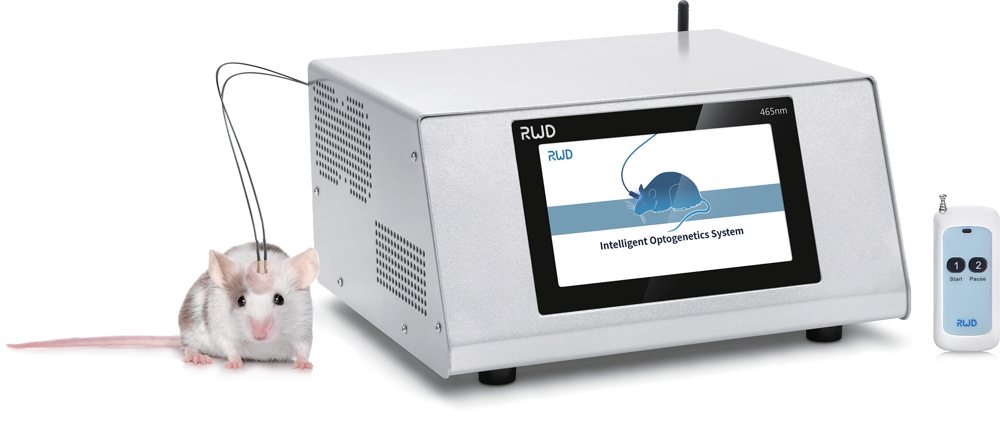
Light-controlled neurons, precisely timed
Optogenetics uses light-sensitive proteins to control biological processes. Light gives spatial and temporal precision, is easy to tune and reverse, and has few side effects, which makes it a core tool in neuroscience.
High stability
Output power stability better than 1%.
Remote control
Start and stop from up to 10 m away.
Fast response
Accepts external TTL-style trigger input from 2–10 V.
Multiple trigger modes
Edge, Real-Time and Gate modes to sync with behavior or recording systems.
Built-in safety
Password lock, over-temperature alarm and running-program prompts.
Program storage
Save protocols to internal memory or a USB flash drive.
Technical parameters
| Power | 0–100 mW, 1 mW resolution |
|---|---|
| Stability | <1% |
| Wavelength (optional) | 450, 465, 532, 589 or 610 nm |
| Remote control range | 10 m |
| Trigger input | 2–10 V |
| Output | 10 mV–5 V |
| Trigger modes | Edge / Real-Time / Gate |
| Safety | Password; high-temperature alarm; program-running prompt |
| Storage | Internal memory / USB flash drive |
Trigger modes
Edge. When the trigger voltage reaches the set value, the program starts and runs for its set duration. On only.
Real-Time. The program runs while the trigger voltage stays at or above the set value and stops when it falls below. Duration follows the trigger.
Gate. Power comes from the first selected sub-program; other parameters are set by the external device. Responds to square waves up to 500 Hz.
Pair with RWD ceramic ferrule holders (68214 / 68215) for fiber implantation, and with the R821 fiber photometry system for recording.